SLIDES

The following slides are excerpted from the Introduction to Logic slides. They serve as examples of the kinds of slides that are screen-shared and discussed over Zoom and are representative of the substance, style, and pacing of the notes for this course. The sources from which these notes are derived are listed on the final two slides.


Slide titled "Introduction to Logic" with a definition stating, "Logic: The organized body of knowledge, or science, that evaluates arguments."
Slide titled "Introduction to Logic" explaining that logic is the study of methods and standards of inference, with a definition of inference as a conclusion drawn from known or assumed facts or statements.
Slide titled 'Introduction to Logic' with a beige background, displaying a description of the aims of logic, emphasizing the development of methods and principles for evaluating and constructing arguments.
A slide titled 'Introduction to Logic' explaining the concept of an argument, defining it as a group of statements that are claimed to support or justify a conclusion.
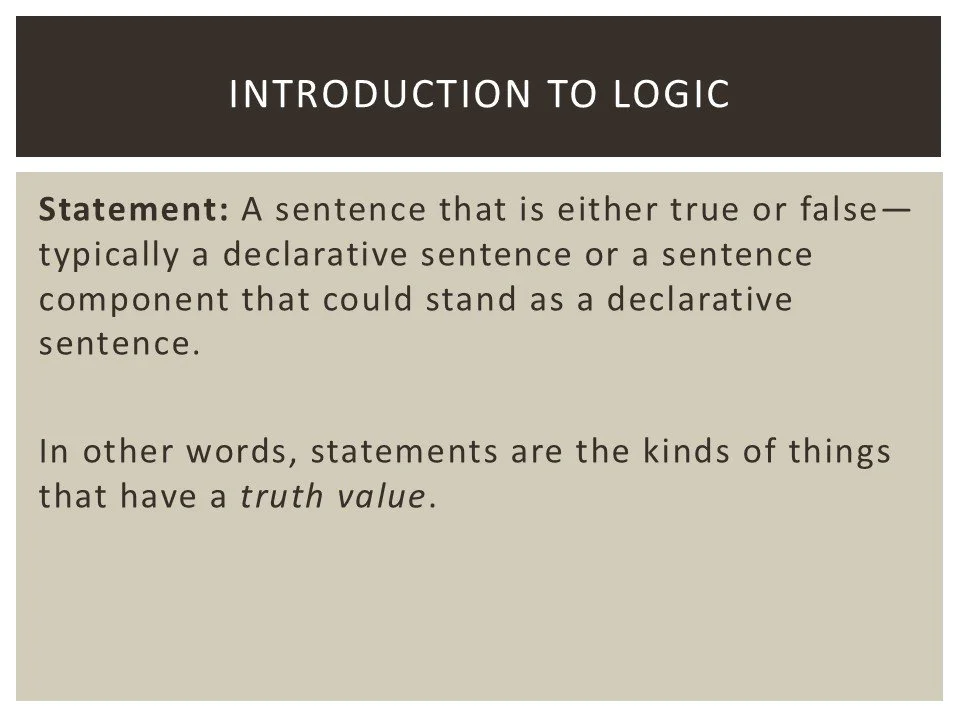
Slide titled 'Introduction to Logic' explaining that a statement is a sentence that is either true or false, typically a declarative sentence, and that statements are things with a truth value.
Slide titled 'Introduction to Logic' with a definition of 'Truth value: a value indicating the relation between the claim and truth, usually 'true' or 'false'.
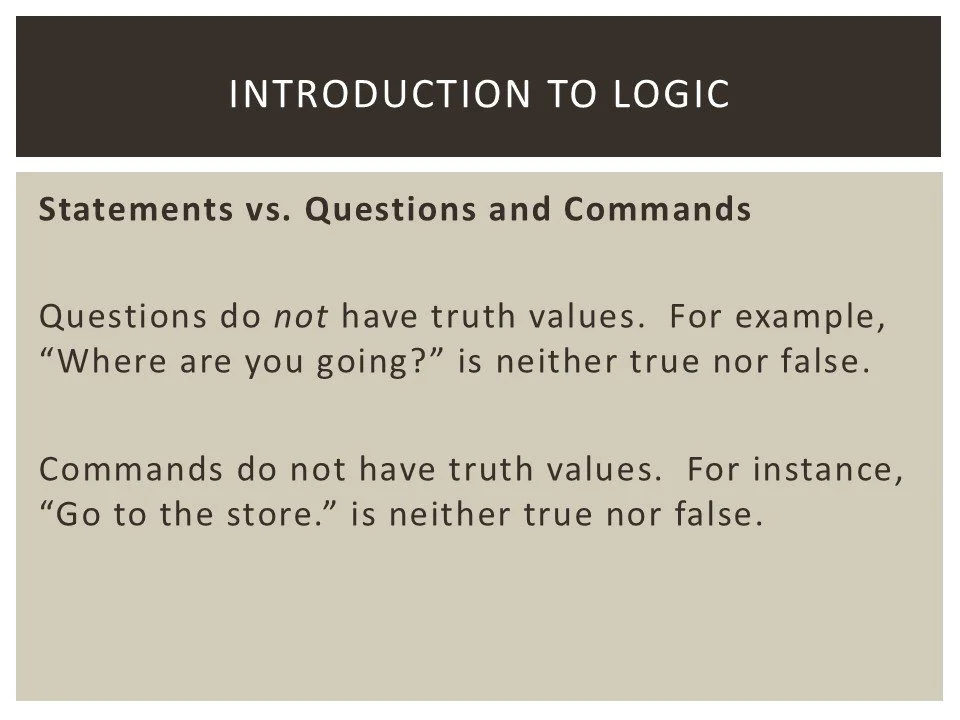
Slide titled 'Introduction to Logic' explaining that questions do not have truth values, using an example question 'Where are you going?' that is neither true nor false. It also states commands do not have truth values, with an example command 'Go to the store.' that is neither true nor false.
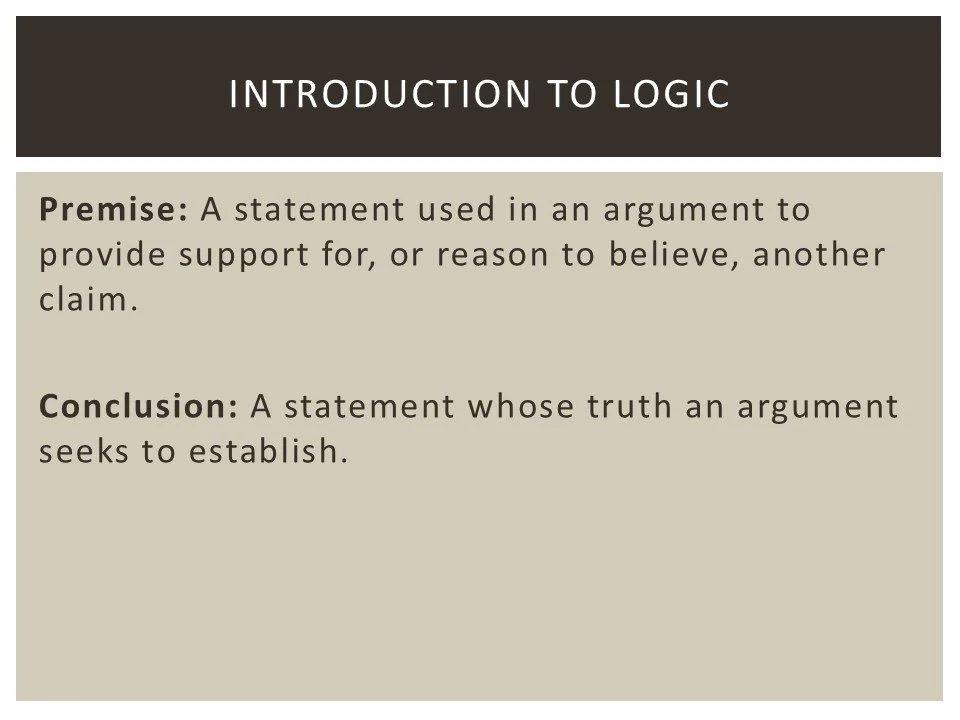
Title slide with the text 'Introduction to Logic' and definitions of 'Premise' and 'Conclusion' on a beige background.
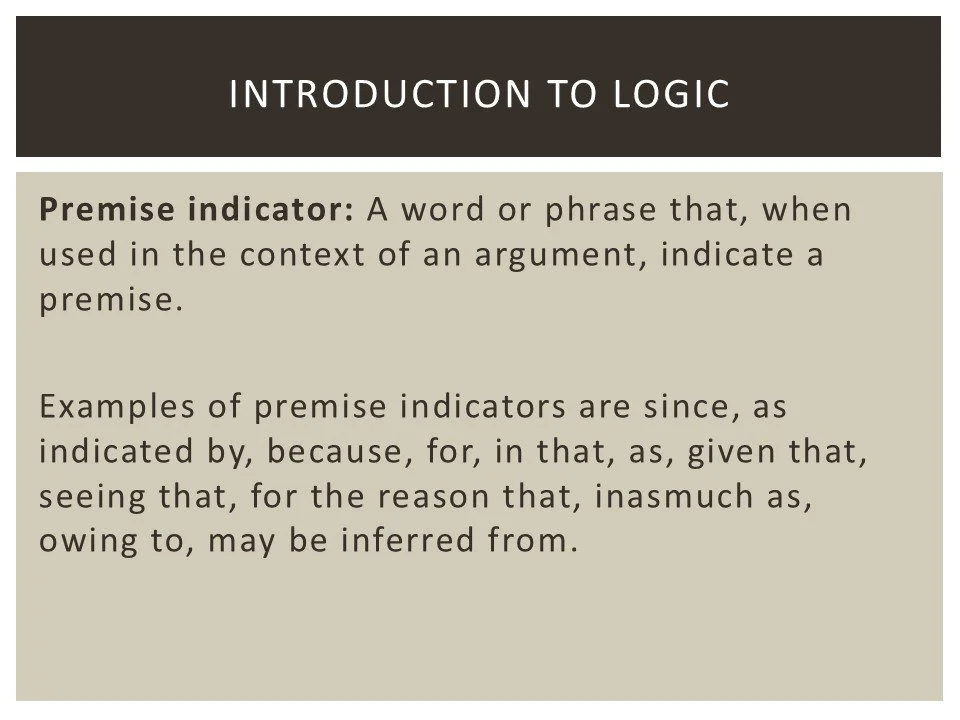
Introduction to logic with text explaining premise indicators, such as because, for, in that, as, given that, seeing that, for the reason that, inasmuch as, owing to, may be inferred from.
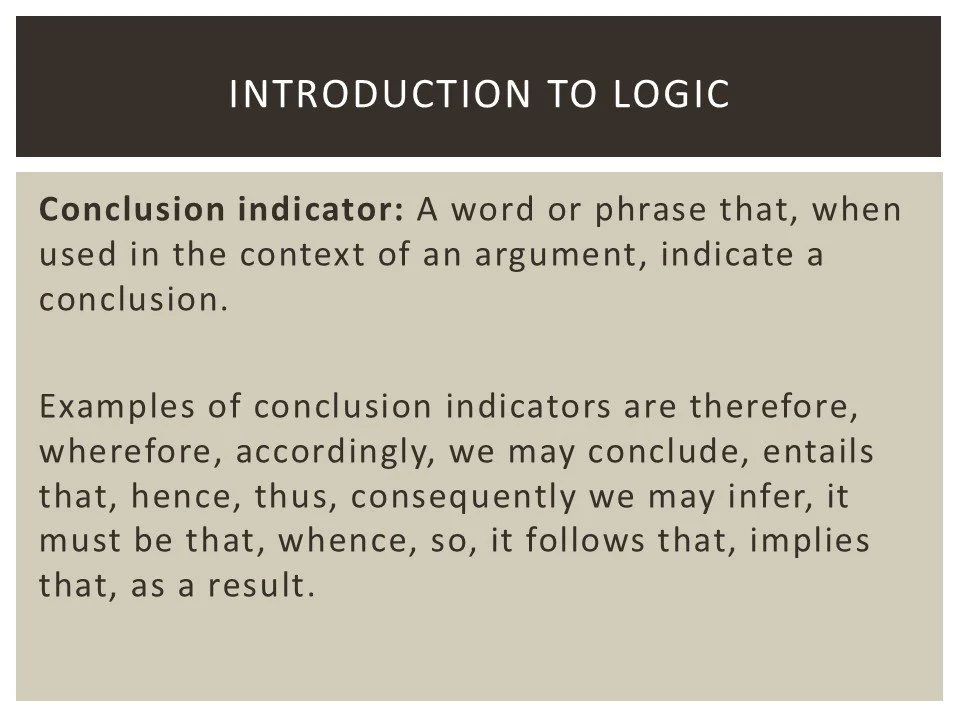
Introduction to logic, explaining conclusion indicators such as therefore, consequently, hence, thus, implies that, must be that, whence, so, it follows that, and as a result.